
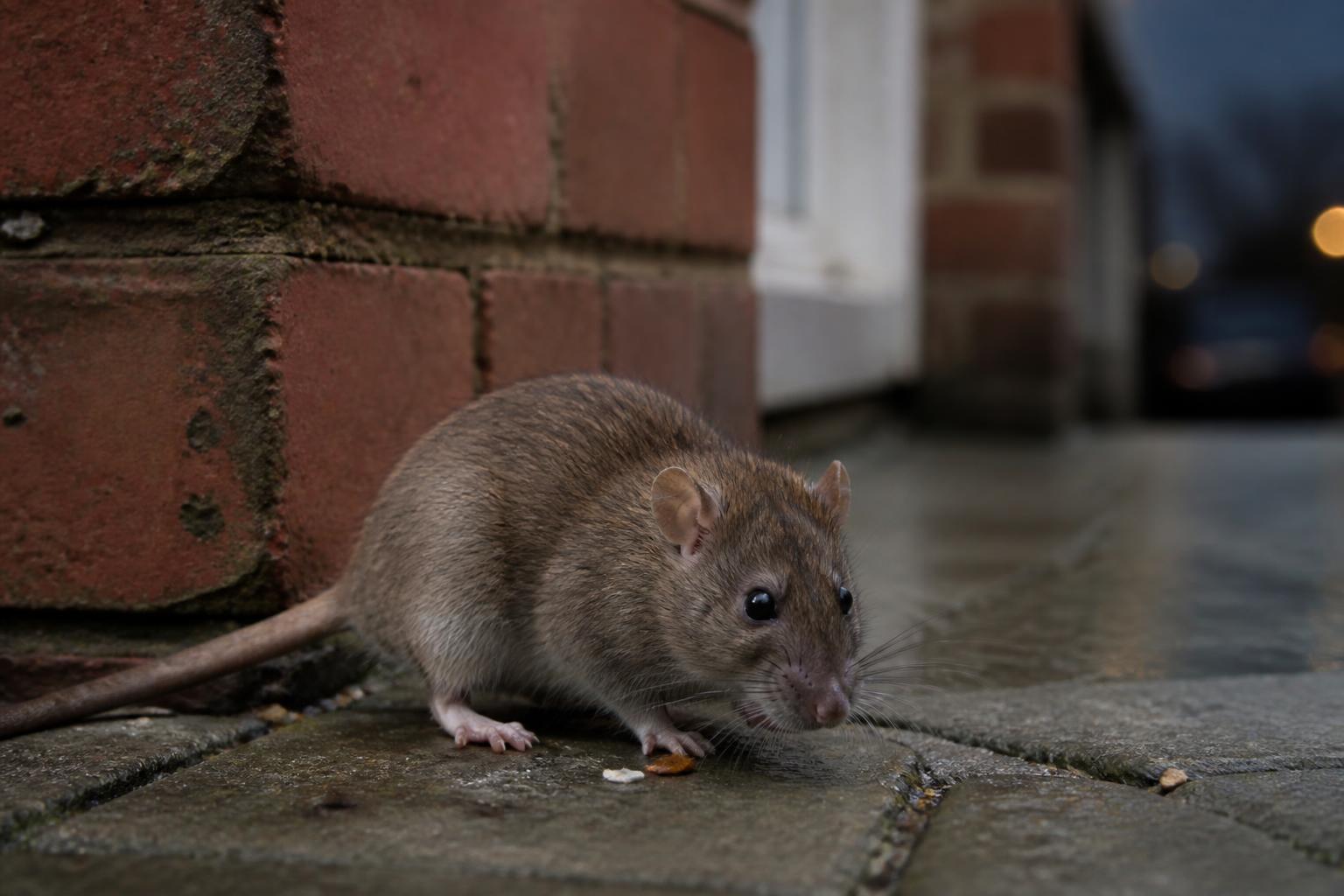
Brown rat
Rattus norvegicus
The UK's most common commensal rodent — an adaptable burrowing mammal that follows drains, food waste and warmth into Hertfordshire homes and businesses.
Quick facts
- Adult weight
- 300–500g
- Litters per year
- 3–6
- Gap needed to enter
- 15mm
- Peak season
- Autumn–winter
Also known as: Common rat, Norway rat, Sewer rat
Species at a glance
High risk- Scientific name
- Rattus norvegicus
- Alternative names
- Common rat, Norway rat, Sewer rat
- Average size
- 20–27cm body, tail slightly shorter
- Average weight
- 300–500g
- Activity
- Nocturnal
- Diet
- Omnivorous and opportunistic. Cereals, food waste, pet food, bird seed, fallen fruit and compost make up most of the urban diet. An adult rat needs roughly 30g of food and 60ml of water a day, and will readily cache food near the nest.
- Typical habitat
- Burrows, drains, sub-floor voids and loft spaces
- Active season
- Year-round, peaking autumn to winter
Why the high risk rating: Disease carriage, contaminated food and gnawed electrical cable.
About the brown rat
The brown rat is not native to Britain. It arrived on trading ships from Asia and Russia in the early 1700s and rapidly displaced the smaller black rat. It is a burrowing, neophobic and highly adaptable mammal that lives wherever people concentrate food, shelter and water. In Hertfordshire it is found in sewers and drain runs, railway embankments, riverbanks, farm buildings, decking, garages and — when the weather turns — inside cavity walls and lofts.
- Diet
- Omnivorous and opportunistic. Cereals, food waste, pet food, bird seed, fallen fruit and compost make up most of the urban diet. An adult rat needs roughly 30g of food and 60ml of water a day, and will readily cache food near the nest.
- Breeding
- Sexually mature at around 10–12 weeks. A female can produce 3–6 litters a year of 6–11 young, meaning a single undisturbed pair can generate several hundred descendants within a year under good conditions.
- Lifespan
- Typically 9–18 months in the wild; up to 2–3 years in exceptionally sheltered conditions.
How to identify it
- Body 20–27cm with a thick, scaly tail slightly shorter than the body
- Coarse grey-brown fur, paler underside, blunt nose and small ears relative to the head
- Adults typically 300–500g — far heavier and stockier than a house mouse
- Droppings 15–20mm, dark, spindle-shaped and tapered at one end
Signs, behaviour and where they live
Signs of activity
- Dark, tapered droppings clustered along walls, in cupboards or in loft insulation
- Greasy smear marks where fur repeatedly rubs beams, pipes and joists
- Gnaw damage to cables, plastic pipework, food packaging and timber
- Scratching or heavy scurrying overhead at night — heavier than a mouse
- Burrow holes 60–90mm across near sheds, decking or garden walls
- A strong, persistent ammonia-like smell in enclosed voids
Behaviour
- Primarily nocturnal, most active in the hours just after dusk
- Neophobic — suspicious of new objects, which is why bait take can be slow at first
- Strong swimmers, able to travel through drainage systems and enter via toilets
- Follow established runs along walls and edges, leaving greasy smear marks
- Gnaw constantly to keep continually growing incisors in check
Where you'll find them
- Burrow systems beside sheds, decking, compost heaps and garden walls
- Defective or unsealed drain runs, inspection chambers and disused pipework
- Sub-floor voids, cavity walls, loft insulation and boxed pipe runs
- Commercial bin stores, food-waste areas and external service ducts
Seasonal activity in Hertfordshire
Twelve-month activity profile for brown rats, based on our Hertfordshire call-out records.
- JanJanuary: Moderate activity
- FebFebruary: Moderate activity
- MarMarch: Moderate activity
- AprApril: Moderate activity
- MayMay: Moderate activity
- JunJune: Moderate activity
- JulJuly: Low activity
- AugAugust: Low activity
- SepSeptember: Rising activity
- OctOctober: High activity
- NovNovember: High activity
- DecDecember: High activity
- Peak period
- September to January
- Right now
- Rising activity in September
Harvest, falling temperatures and the first frosts push rats from field margins and river corridors into buildings — Hertfordshire call-outs climb sharply from late September.
Brown rats typically become more noticeable from around now. Harvest, falling temperatures and the first frosts push rats from field margins and river corridors into buildings — Hertfordshire call-outs climb sharply from late September.
Current local data is limited. The status shown is based primarily on established seasonal behaviour across Hertfordshire. Last reviewed 1 July 2026.
See all Hertfordshire Pest Watch activityWhy brown rats matter
Health risks
- Leptospirosis (Weil's disease) carried in urine and contaminated water
- Salmonella, Cryptosporidium and E. coli contamination of food surfaces
- Rat-bite fever and secondary infection from bites or scratches
- Fleas, mites and ticks introduced into the property with the rodents
Property damage
- Gnawed electrical cable — a recognised cause of domestic fire
- Punctured water and gas pipework, leading to leaks and escape risk
- Compacted and fouled loft insulation, reducing thermal performance
- Damaged airbricks, soffits and drainage that create ongoing entry routes
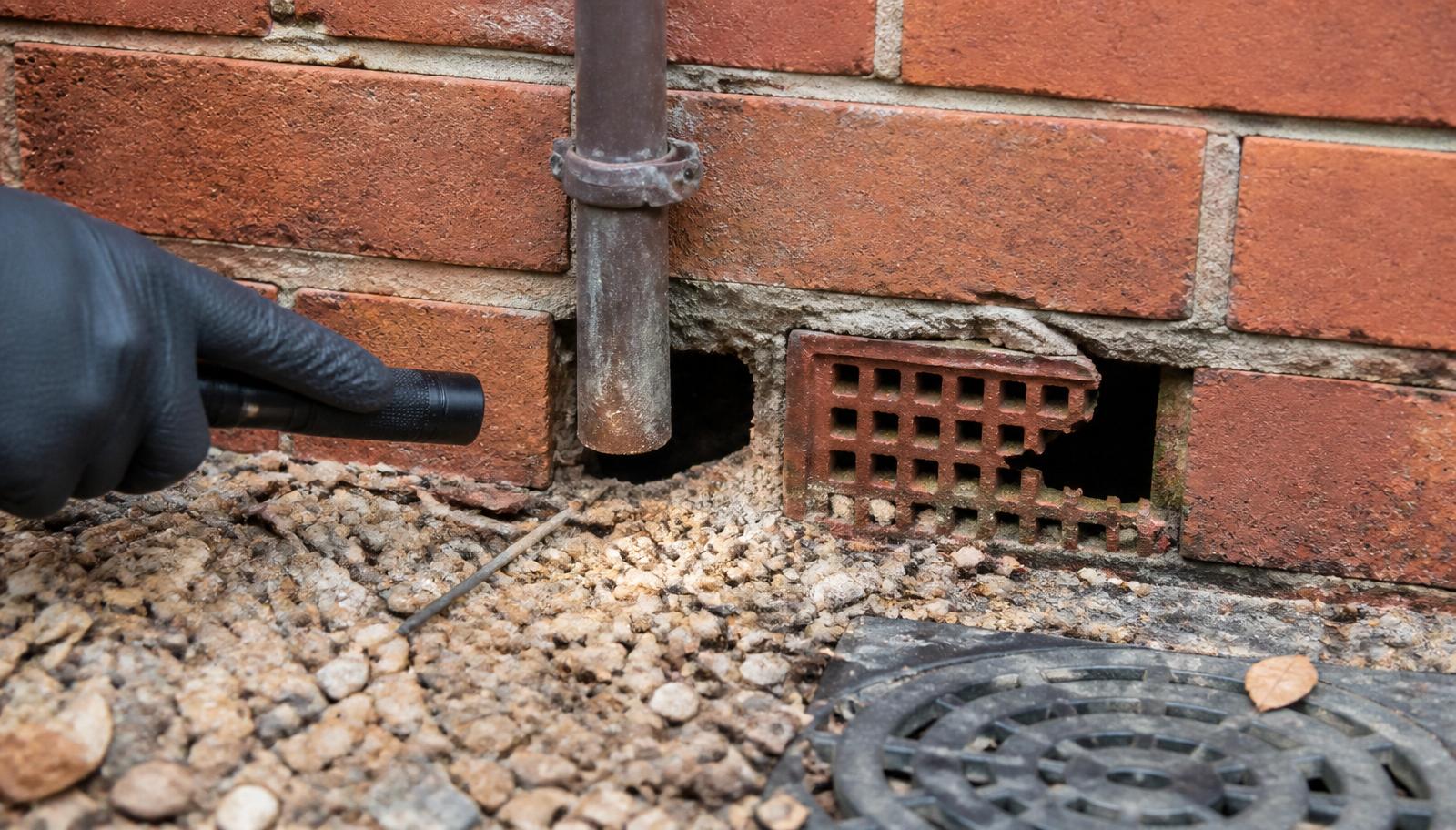
Broken air bricks and pipe gaps are the most common rodent entry points we find.
Brown rats across Hertfordshire
In Hertfordshire, most rat problems we attend trace back to broken or unsealed drain runs in older housing stock, and to farmland and river corridors — the Lea, the Ver and the Colne — pushing rats indoors each autumn. New-build developments across Stevenage, Hemel Hempstead and Bishop's Stortford also disturb established burrow systems during groundworks.
What brown rat evidence looks like
External entry point
Gnawed gap at a service pipe entry — the classic route into a sub-floor void.

Activity inside a void
Runs, smear marks and disturbed insulation recorded during a loft inspection.
Common misconceptions
Seeing a rat in daylight means the infestation is enormous.
Daytime sightings often mean competition or disturbance, not necessarily large numbers — but they always mean an established population worth investigating.
You are never more than six feet from a rat.
This is a Victorian invention with no basis in survey data. Density depends entirely on food, harbourage and drainage condition.
Shop-bought bait will solve it.
Amateur bait frequently kills a few individuals in inaccessible voids and leaves the entry point untouched, so the problem returns within weeks.
Prevention and professional treatment
How to prevent them
- CCTV drain survey where activity is indoors and no external entry is obvious
- Seal gaps over 15mm at service entries, airbricks, soffits and door thresholds
- Remove ground-level food sources: bird feeders, fallen fruit, open compost, pet food
- Keep bins closed and stored clear of walls and fence lines
- Cut back dense ground cover and ivy that provides cover for runs
How we treat them
- Full internal and external survey mapping runs, harbourage and entry points
- Targeted rodenticide in tamper-resistant stations, or trapping where bait is unsuitable
- Drain inspection and repair recommendation where the route is subterranean
- Physical proofing to close every identified entry point
- Follow-up visits until zero activity is confirmed, with a documented service record
Brown rat questions, answered
The questions our technicians are asked most often about brown rats in Hertfordshire.
Ask anything about the brown rat
This assistant is reading the brown rat profile with you — there's no need to say which pest you mean. Answers are educational and evidence-based.
Questions are recorded anonymously so we can improve HPE Knowledge. No personal data is stored.
Related content in HPE Knowledge
Related species
Related services
Related knowledge
- Prevention guidePractical proofing and housekeeping steps for this species.
- AI Pest IdentifierNot sure what you have? Describe it and get an identification.
- Hertfordshire Pest WatchSeasonal activity across Hertfordshire, reviewed by our technicians.
- Treatment LibraryDocumented treatments and case studies from real jobs.
- Evidence GalleryLabelled field photography showing exactly what to look for.
- Professional Service RecordsSigned, time-stamped records issued after every visit.
Helpful next steps
Professional treatment
Speak to a technician about brown rats at your property. Fixed price confirmed after a brief inspection.
View treatment optionsView evidence gallery
Labelled field photography showing exactly what the signs look like in a real property.
See the evidenceBrowse the Treatment Library
Documented case studies from treatments carried out across Hertfordshire.
Open the libraryAsk HPE Knowledge
Put a question directly to our brown rat assistant and get an evidence-based answer.
Ask a questionCheck CoverageMaps Pro
Confirm we cover your town, village or postcode and see local activity.
Check coverageContact Hertfordshire Pest Experts
Prefer to talk it through? Call the team or send the details of what you have found.
Get in touchOr head back to the HPE Species Library to compare species.